

Air Conditioning Services
Get Ready to Beat the Heat
Air conditioning is a must-have for hot, humid Michigan summers. For over three decades, our team of experts has led climate control solutions for both homes and commercial facilities. Our range of energy-efficient options save you money over time without sacrificing cool comfort.
Our Air Conditioning Services
AC Repair

AC System Installations

AC System Replacement
Plan Ahead for Refrigerant Changes
To ensure you’re getting the best heating and cooling solutions, we stay up-to-date on industry developments so you know what to expect.
Starting January 1st, 2025, manufacturers will start phasing out R-410A refrigerant from their products. Join Chad as he walks through the two new refrigerants, R-454B and R-32, so you can make confident decisions for your home.

Air Conditioning Issues You May Encounter
It’s not uncommon for air conditioning systems to encounter issues over the course of their lifetime. While inconveniences may start as minor, they can develop into more serious problems.
Poor Cooling Performance
A dirty air filter, refrigerant leaks or a malfunctioning compressor could be to blame.
Strange Noises
Blower fan, compressor or ductwork issues can lead to banging, hissing, rattling, or squealing.
Leaking Water
Clogged drains or a malfunctioning condensate pump can cause this issue.
Uneven Cooling
Uneven room temperatures could be from ductwork problems, insulation issues or an improperly sized AC unit.
Thermostat Problems
Inaccurate temperature readings, an unresponsive thermostat or incorrect settings can result in comfort issues.
Frequent Cycling
A dirty filter, thermostat issues or an oversized AC may cause units to turn on and off frequently.
High Energy Bills
Clogged filters, dirty coils or refrigerant issues can cause unit inefficiencies, leading to higher energy bills.
Airflow Problems
Poor airflow can result from issues with the blower fan, duct work blockages, or a faulty motor.
Age-Related Wear and Tear
AC units become more prone to breakdowns and efficiency loss as they become older, potentially requiring replacement.
Forced Air Cooling System
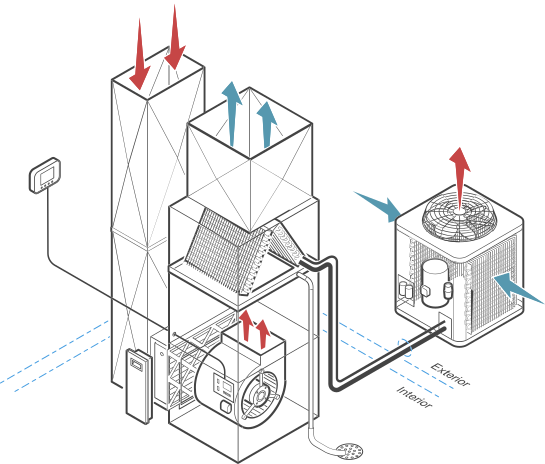
Warm Air Return
Cool Air Supply
Evaporator Coil
Compressor
Fan
Condensing Coil
Condensation Drain
Blower Motor Assembly
Control Board
Air Filter Access
Wall Thermostat
Why Choose Baumann & DeGroot

Top-Notch Techs
Creative problems require creative solutions. Our technicians know how to make it happen.

Pricing Tailored to You
You only pay for what you actually need. Our prices are based on your project, not some arbitrary standard.

A Culture of Care
You’ll feel how the care we have for our team gets passed to you. You won’t find a more genuine group.

Exceptional Customer Service
When you call us, expect a real person to pick up the phone. We’re here to make this simple for you.

Here For the Long Haul
We love our people. From customers to our techs, the folks that work with us tend to stick around.
FAQs
Quick answers to frequently asked questions about air conditioning.
How does an AC work?
An air conditioner actually removes heat from your home. The system circulates refrigerant between the indoor and outdoor units, absorbing heat from the warm air inside your home as it passes over the cold evaporator coil. That heat is then carried outdoors where it’s released through the condenser coil. A compressor continuously pumps the refrigerant through this cycle, and a blower fan circulates your home’s air across the coils. The result is that heat is continuously removed from your indoor air and expelled outside, leaving your home cooler.
What is a refrigerant and why is it important to an AC?
Refrigerant is a chemical compound that cycles through your AC system and makes the heat transfer process possible. It has the unique ability to absorb large amounts of heat when it evaporates and release that heat when it condenses (turns back to liquid). Without refrigerant, or with too little of it, your AC cannot transfer heat effectively and will struggle to cool your home.
How do I take care of my AC system?
The most impactful things you can do as a homeowner are replacing your air filter regularly, keeping the area around your outdoor condenser unit clear of debris, leaves, and overgrown vegetation, make sure your indoor vents aren’t blocked by furniture, and keeping up with annual maintenance.
What does the AC replacement process look like?
The process typically starts with an evaluation of your current system, your home’s size and layout, and your comfort goals to recommend the right replacement unit. Once you select a system, the installation team removes the old equipment, makes any necessary modifications to your ductwork or electrical connections, installs the new unit, and tests it thoroughly to confirm it’s running correctly.
Could my thermostat be affecting my AC's performance?
Absolutely. Inaccurate temperature readings, an unresponsive thermostat, or incorrect settings can all lead to comfort issues and cause your system to behave erratically.
Does my furnace filter really impact my AC?
Yes. In most homes, the furnace and AC share the same air handler and ductwork, and the furnace filter is the primary filter for the entire system. When that filter is dirty and clogged, airflow to the AC’s evaporator coil is restricted, which reduces cooling efficiency, causes the system to work harder, and can lead to the coil freezing over.
Why have my energy bills gone up?
Clogged filters, dirty coils, or refrigerant problems can reduce your system’s efficiency, causing it to work harder and use more energy than it should. Regular maintenance helps keep these issues in check.
How does age affect my AC system?
As AC units get older, they become more prone to breakdowns and lose efficiency over time. If your system is aging and requiring more frequent repairs, it may be approaching the point where replacement is the more cost-effective choice.
What's the difference between a central AC system and a ductless mini-split?
A central AC system distributes cool air throughout your home via ductwork, while a ductless mini-split delivers cooling directly to individual rooms without ducts. Ductless systems are a great option for homes without existing ductwork or for areas that need supplemental cooling.
How does a forced air cooling system work?
A forced air system pulls warm air from your home through a return vent, passes it over an evaporator coil to cool it, and then pushes the cooled air back through your vents via a blower motor. Key components include the compressor, condensing coil, evaporator coil, air filter, and thermostat.

Schedule a Free Consultation
Every project is unique. Talk to one of our experts to determine the best solution for you and your home.